It’s About Light
A Guest post by Lin Junjiefrom Phocus Academy.
When I first started out in photography many years ago, I didn’t quite appreciate how important light is to photography.
In fact the young and ambitious me often fought against light.
I refused to be restricted by something as fickle as the weather and light. After all, a good photographer should be able to make anything look good—whether it’s noon, sunrise or dusk, right?
The result of my foolhardiness was that I often end up with photos with highlights that are too bright and shadows that are too dark for my camera to handle because I shot them at 12 noon. Or worse—I end up making my human subjects look like racoons because of the high overhead noon light.
Due to the poor lighting I shot the photos under, I wasn’t comfortable showing others the photos that I’ve just taken on my camera because they didn’t look good without extensive post-processing.
Truth as I learnt is that even the most mundane things on a simple handphone camera can look good in great light, and they can look really good right away without needing any or much post-processing at all.
As a photographer who understands how light can make or break a photo, I now only choose to photograph my day shots at two timings of the day known as the magic hours (or golden hours). In practical terms, they’re basically an hour or two after sunrise, and an hour or two before sunset. The exact timing will depend on where you are and which part of the year you are in.
Here in Singapore where we’re situated close to the equator, and the magic hours are almost always from 7-8.30am and 5-6.30pm. At these hours, light is most interesting because of three reasons:
- light is directional and that provides interesting side lighting that can emphasize shape and texture, in addition to casting long, interesting shadows of your subjects,
- light has a more warmer and more attractive colour than midday sun (thus the name ‘golden hour’), and
- light quality is softer and produces highlights and shadows that your camera can deal with more easily than the extremely contrasty light produced by the high midday sun.
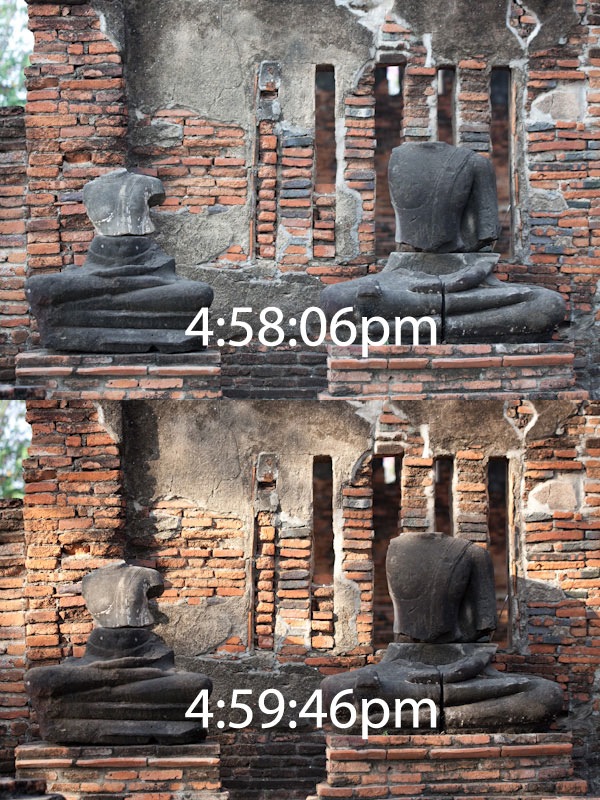
To illustrate, I was photographing the temple ruins at Ayutthaya in Thailand sometime late last year. Although I had chosen to shoot in the evening magic hours, the strong cloud cover that day would constantly block and diffuse the warm evening sun.
However I knew I would get a dramatically different—and better—shot once the sun breaks through the clouds and lit the scene in front of me.
Sure enough, patience paid off and I got myself the shot I was looking for. The shots were taken less than 2 minutes apart but made a world of a difference.
While I am not usually inspired to photograph my neighbourhood in the same way as I would photograph the world heritage site of the temple ruins in Ayutthaya, mundane everyday sights in my neighbourhood can look gorgeous in the right light.
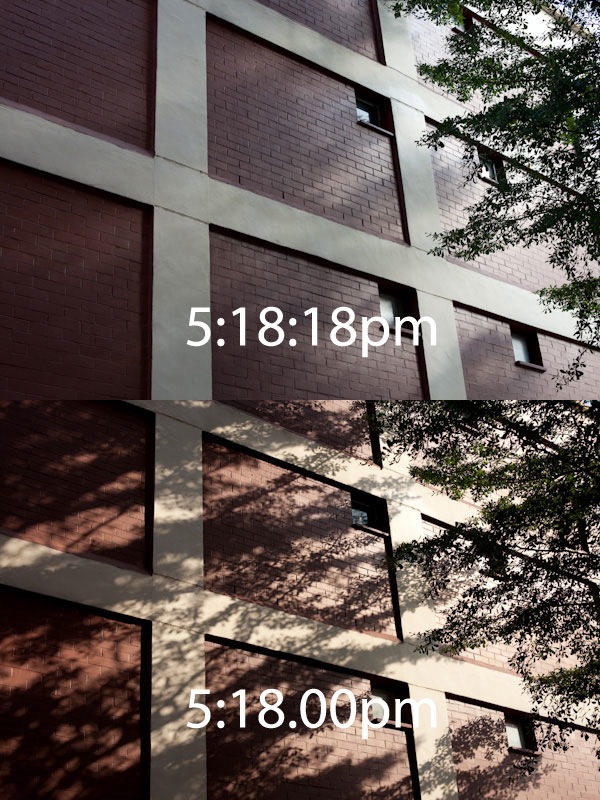
On one occasion on my way back home, I saw how the evening light was casting beautiful shadows of the trees on the apartment blocks nearby. I quickly returned home, grabbed my camera and took two a few shots of the scenes around me.
Within a span of 18 seconds, I had two completely different photos of the same scene.
So while choosing to shoot at the magic hours dramatically increases your chances of getting a good photo, you’re still very much subjected to the weather and cloud cover. But if you choose to fight against light and photograph at the less ideal timings, chances of you getting a good photo are probably terribly slim.
In the world of photography today where people obsess themselves over expensive gear and equipment, light is probably the most understated part of photography.
I often tell my students that learning to appreciate and exploit great light is probably the single, biggest improvement you can do to your photography, even more so than spurlging their paycheque on the expensive lens they’re eyeing after.
Lin Junjie is a professional photographer and photography instructor based in Singapore. He conducts photography workshops and courses in Singapore at Phocus Academy.




49 Responses to “It’s About Light” - Add Yours
June 13th, 2010 at 6:48 am
Rarely impatient people get good photos
)
A great post! Indeed light is defenitely one of the most important pillars of photography, and I think it should be considered in its 3 main streams: direction of light; color of light (warm or cold) and intensity of light, so just playing with these 3 elements you can really master it!
June 13th, 2010 at 6:59 am
Finally an article wherein the photos actually support the point!
June 13th, 2010 at 7:13 am
I just got home from an overcast day at a new-to-me beach on Lake Michigan, but there was some interesting houses and dunes to make use of so I’m hoping at least one or two are decent shots.
I’m stunned at your comparison shots. They prove your point very well! Thank you for adding them and pointing this out. I’m still barely getting started, but I’ve not heard a single thing about this yet, and see how true it is with your explanation.
June 13th, 2010 at 7:15 am
I agree almost entirely, but it is worth noting that it’s not impossible to get good shots at times that aren’t considered ideal.
Sometimes you don’t have much choice but to shoot outside in the middle of the day, for example. In this case, you might have to use additional equipment such as a light diffusing screen, or just be careful exactly where you shoot.
June 13th, 2010 at 7:30 am
good job
June 13th, 2010 at 7:32 am
I love the images in this article. They are so specific to what the article is. They are pretty, expressive, and spot on.
June 13th, 2010 at 7:32 am
Good post – I agree with with the effects of light within a couple of minutes.

This was taken around 3 pm (sun set was around 7pm)
A little while later, just a few metres away from above, and when sun broke from the clouds
Not sure if shooting in the golden hour would have produced the same effect. What do you think?
June 13th, 2010 at 8:48 am
Thank you for explaining this concept so clearly. As a beginner, I really appreciate the visuals to illustrate and reinforce the lesson in the article. My young daughter recently asked me what photography actually was and I explained that it’s using a camera to make a picture of light. Now as we drive around our rural town, she loves to point out interesting light that she sees. Nothing like developing her eye early!
June 13th, 2010 at 9:11 am
Yes, less spurlging, more “non nisi parendo vincitur” (Nature is only mastered by obedience to her laws)
June 13th, 2010 at 12:36 pm
I wish the sun would break through in Taipei occasionally! Getting plenty of these shots though:
June 13th, 2010 at 1:20 pm
Finally, a very helpful article that goes back to what photography is really about, sans expensive gear, gimmicks and post-processing. Love how you illustrated it, too. Thanks!
June 13th, 2010 at 3:44 pm
I enjoyed the assignment we were given to take pictures in 5 different types of lighting. Until this assignment I didn’t know there were so many different types of lighting.
June 13th, 2010 at 6:51 pm
I agree and don’t agree with this article. YOU can get great photos at any time of day you just need to use the right tools to do it. Get any of Brian Peterson books or videos and he will show you how to break those rules. Dawn and Sunset give the Ideal light but its a rule meant to be broken when needed.
June 13th, 2010 at 10:38 pm
Light is the key in all cases. Sure you can often create your own light, or manipulate what is there, but the key is understanding that fact. This also took me a while to grasp, as it seems to simple to be important. Good article.
– http://www.lightshootedit.com
June 13th, 2010 at 10:39 pm
Light is the key in all cases. Sure you can often create your own light, or manipulate what is there, but the key is understanding that fact. This also took me a while to grasp, as it seems to simple to be important. Good article.
lightshootedit.com
June 14th, 2010 at 12:48 am
The word photography comes from two greek words meaning light and write – so it is writing with light.
Just like the hardness of your drawing pencil, the quality of the light makes a big difference to the feel of the picture.
June 14th, 2010 at 3:24 am
Try using filters for a subtle warming or cooling of the light or deeper colours will create dramatic effects that need no post processing.
June 14th, 2010 at 5:32 am
It’s truly amazing how much the lighting of a situation can make shots so much more interesting. I love your use of shadow in a few of the shots up there. I really need to start implementing more shadows into my photography.
June 14th, 2010 at 6:43 am
Great article. Elemental and to the point.
June 14th, 2010 at 7:12 pm
WOW! GREAT ARTICLE! so THAT`S why my photos never look like the pro’s, I totally ignored the light =P ok maybe that and the fact that I’m a total newbie =) but really, GREAT article, great illustration pics. Thanks a lot to DPS for their great work and to Lin Junjiefrom for this great piece of advice =D
June 15th, 2010 at 7:23 am
I loved this! I live by this rule as well<3
June 15th, 2010 at 2:07 pm
I really liked the format of this article with the different time stamped shot. Pretty amazing what just a few seconds difference can have on a shot. I would like to see more posts like this one. Well done.
June 15th, 2010 at 2:18 pm
You don’t always have the choice to choose the hour of the day you need to shoot, specially during family parties, and vacations. It would be nice to have an article on how to property deal with such times without caring tons of equipment.
June 15th, 2010 at 9:19 pm
Great article. Well written also shows very clearly what the subject was about. Well done.
June 15th, 2010 at 9:35 pm
The images are more of ‘Shadows’ than ‘Light’… two different photography themes.
June 16th, 2010 at 8:07 pm
wow thats nice. the difference between the 2 shots of the trees against the building few seconds apart is really inspiring and amazing!!
June 17th, 2010 at 1:31 am
great article, i agree light is very important and can really make a shot!
June 17th, 2010 at 3:50 am
Great article Lin, thanks! I love your examples just a small amount of time apart.
June 17th, 2010 at 9:54 am
Interesting. Without direct light there are no shadows. There is a place for each:diffused light & direct light.
June 18th, 2010 at 1:47 am
I am actually so proud to say that a Singaporean has finally made it up here! [:
Singapore is so small and yet there are so many photographers here.
Some people living in the bigger countries do not even know where we’re located! [:
Good job dude!
June 18th, 2010 at 3:26 am
Great Advice: BUT — What we really want to know is how do you take great pictures when the light cannot be delayed. Went to my son’s college graduation (outside) and it wasn’t over until 11:30 am. Totally bright mid day California sun. What do you do? You can’t wait six hours for the sun to start going down — the event is NOW!!
June 18th, 2010 at 3:34 am
Wow, That is dramatic! What a difference a couple of seconds can make!
June 18th, 2010 at 3:48 am
Very insightful article. I learnt the same thing recently (the hard way) on my recent italy trip.
June 18th, 2010 at 4:28 am
Excellent examples! Great article. Thank you.
June 18th, 2010 at 5:13 am
Profound examples! Lighting is key to outstanding photography!! Great article.
June 18th, 2010 at 5:44 am
It can be a helpful article about light.
June 18th, 2010 at 5:53 am
You are so right and I love your story. Did the same mistake even though I had been told 100 times that it’s all about light.
Since then I wait and wait and wait until I feel the light is just right. I took this one as the sun was setting through the arches of a castle.
http://martinsoler.com/2010/01/17/when-the-sun-sets/
June 18th, 2010 at 6:31 am
i’ve come to appreciate very much the light games that make a photo
but i think that though the great light effects are in the golden hours
sometimes paying attention to what the light can give you in a photograph can make a difference between a good picture and a bad one, but you should know how to use it through all the hours of the day.
for instance, i took the following photograph at 11:00 am in the morning at my home
and by using the light, i shot a photograph of my daughter that i realy love (my daughter and the photo of course
)
http://www.flickr.com/photos/amirpaz/4685549988/
i also love to shoot at the golden hours and get the light to create the image and make it unique
this photo i took at dusk, an hour before sunset, and the room was filled with smoke from a smoke machine. the combination along with an actress dressed up as a fairy, made for a picture i realy like:
http://www.flickr.com/photos/amirpaz/4705175415/
in conclusion, knowing to exploit light correctly in photography makes the difference between a photo worth sharing with others, or keeping it to yourself.
great post.
Amir
June 18th, 2010 at 9:12 am
Great Article, but one thing concerns me, why was your camera at home, and not with you, at all times?
June 18th, 2010 at 10:02 am
It makes it easy when the sun starts to sink and the direction and intensity of the light is camera friendly but there’s no reason you can’t get great, well lit shots any other time of day. Here’s some things you can do to take great photos in the harsh mid day sun:
1. Hide your subject in the shade so that the light hitting them is soft, reflected light instead of hard direct sunlight.
2. Use reflectors or flash to fill the harsh shadows caused by the hard light from the sun.
3. Use an off camera flash as your key light and the harsh sun as a hair or rim light.
These methods require little or no extra equipment and in some cases can produce more interesting photos than you would have gotten using the sun alone during the famed “golden hour”.
June 18th, 2010 at 2:22 pm
i am a wedding photographer from India and i am looking forward to purchasing a new gear.I use Nikon stuff .Could any body suggest what lenses i should go for as i have alreadu decided on the body.(Nikon D300).I would like to invest in the best lens avaliable and i already have a nikon 17-55 f2.8.
June 18th, 2010 at 6:15 pm
That is a fundamental question in photography – “What is the most important element in any photograph?”
The answer of course is light.
June 18th, 2010 at 8:31 pm
This is a terrific article and I have enjoyed the discussion.
One more point is that in evening light you can shade the lens of your camera behind a tree and photograph into the evening light so that the shadows are coming towards you. I discovered this by accident and was amazed to see the twisting dramatic shadows leading into the oncoming passers-by, when I got the print back. I was using film though, so had a good tolerance to contrast. Should work in digital with a polariser!
June 18th, 2010 at 10:32 pm
My father-in-law who was a professional photographer until he had to retire because of failing eyesight has told me it’s all about the light. This article shows it, good job.
June 19th, 2010 at 1:56 am
Thanks for the article. A good one. Though I agree with those who have said that we should be able to make photos at any moment of the day. If we always carry our camera with us to catch moments and situations, we will have to deal with the light of the moment. It depends if you want a postcard and a technically good photo or just a great shot.
June 19th, 2010 at 7:24 am
It would help us beginners if the respective settings of the above shots were indicated, e,g, aperture, shutter speed, which white balance, exposure, focus modes, AND whether they have been post-processed extensively. And thank you for the vital advice Lin Junjie. Without realising it I have been obtaining the best shots of a cemetery by the sea (my ancestors’ last resting place) during those golden hours.
Tiberman – Mauritius
June 20th, 2010 at 5:58 am
This is a wonderful post. It took me a good while (and money) after starting digital photography to appreciate that light, position and patience make the shot. Like cooking, it does not matter how good you pots and pans may be, of you do not have the right ingredients you will still get a bland meal. Thanks so much for a great post
June 27th, 2010 at 9:36 pm
This is a great article. Especially the photos taken in singapore. Gives me inspiration to shoot a few photos around the magic hr in singapore.
Might even ask my clients to take photos during those time instead.
October 18th, 2011 at 4:58 pm
Great article Lin!
Now i fully understand why my photos dont have the OOmph factor! Gonna keep on shooting! I agree with Gerald! Not many knows where our little country is! lol
Leave a Reply